When Justice Learns to See
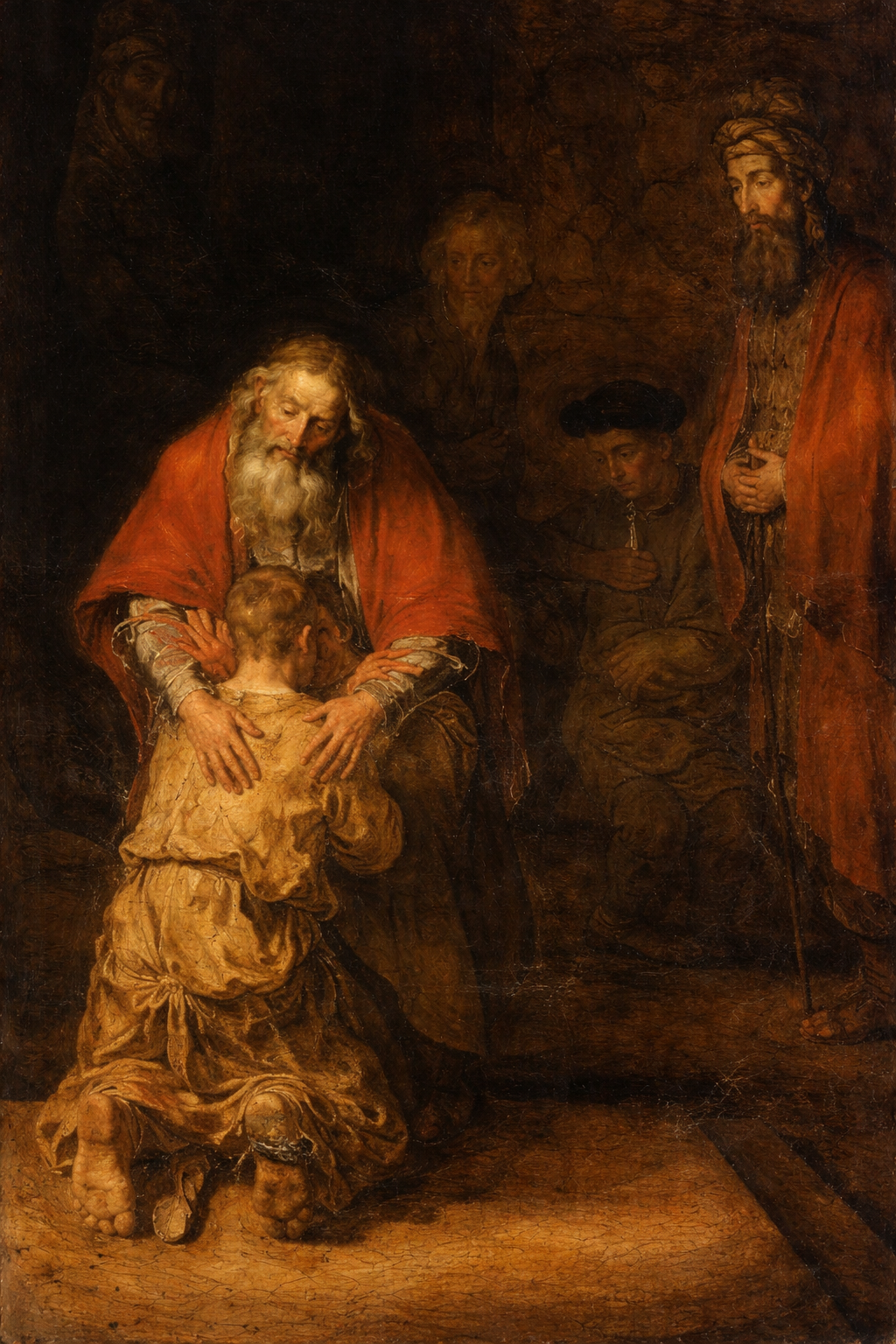
Rembrandt van Rijn, The Return of the Prodigal Son (c. 1668)
There is a story Jesus told that still speaks a better word than many law books ever have.
In Luke 15, a younger son demands his inheritance prematurely. He takes his inheritance and travels into what Scripture calls a far country, a place where dignity is squandered and identity is forgotten.
But then something happens. He came to himself.
His mind turns. His heart turns. His feet turn.
It is one of Scripture’s clearest pictures of repentance, the 180-degree return home.
He prepares a speech, expecting rejection and hoping only to survive.
But the Father sees him. The Father runs. The Father embraces and restores him: shoes for his feet, a robe for his shoulders, a feast for the whole household.
Yet the Older Brother stands outside, arms crossed. He keeps the ledger. He sees only the offense. For him, justice is a calculation. For the Father, justice is restoration.
This is not only a parable. It is a vision for justice. And in 2018, the Indiana legal system faced a choice not unlike the one in that story. The case is Livingston v. State, 113 N.E.3d 611 (Ind. 2018). It is a moment, however brief, when the law reflected something of the Father’s restorative welcome in Luke 15 .
1. The Far Country and the 180-Degree Turn
In 2013, Lisa Livingston was charged with serious drug offenses. Addiction had carried her into a far country of her own.
Then came a gap. Nearly four years passed before sentencing, and in that space, something sacred took root.
She entered Bliss House for recovery. She rebuilt trust. She began serving women caught in addiction. She used personal resources and donations to open BreakAway Home, a place of safety and new beginnings.
Her repentance was not only a feeling. It bore fruit.
2. The Justice of the Older Brother
When sentencing day arrived, the evidence was abundant:
381 days of voluntary monitoring with complete compliance
The arresting officer testified that her life had truly changed
Letters from those who witnessed her transformation
Yet the trial court imposed a 30-year sentence.
This was the justice of the Older Brother: a justice of ledgers, a justice that sees the crime but not the change. A justice that believes punishment alone can address what was broken, though we know it rarely heals.
It was the broken bridge of a system that calculates risk but struggles to recognize repentance.
3. The Rare and Exceptional Justice of the Father
The Indiana Supreme Court reviewed the case.
Appellate Rule 7(B) allows the Court to revise a sentence if it is inappropriate considering:
the nature of the offense, and
the character of the offender.
Character of the offender is the law’s way of asking a deeply biblical question: Who is this person now?
The Court saw the whole story. The offense was serious. The transformation was genuine. They ordered Livingston into community corrections, allowing her to continue the ministry her repentance had birthed.
The Father rejoices when a child comes home. In this ruling, the Court reflected something of the reconciling and restorative moral vision at the heart of the gospel, breaking down the wall of hostility that would have separated a person from her community. For a moment, the law learned to see.
Conclusion: The Summons
Why did the Court call this case rare and exceptional? Because our legal system, like the Older Brother, is more comfortable with ledgers than with feasts. It knows how to count sins. It is far less practiced at recognizing new creation.
Livingston v. State is not only a success story. It is a summons.
It shows what becomes possible when mitigation becomes a bridge a court can walk across. It shows that restoration is not a fantasy. It is a future worth building.
The prodigal returned home once. Our justice system must learn to welcome that return again and again until it becomes the norm rather than the exception.
“Do not despise the day of small beginnings.” (Zechariah 4:10)
We labor for the day when restoration is no longer rare, when courts and communities rejoice at the 180-degree turn, when justice learns to see through the Father’s eyes.
That is the work.
That is the calling.
That is how justice learns to see again.
______________________________________________
Ministry and Legal Ethics Notice
This reflection is for spiritual and educational purposes. I write as a J.D. Candidate, Registered Paralegal, and ordained minister, not as a licensed attorney. Nothing here constitutes legal advice or creates an attorney client or paralegal client relationship.