Love Makes Room
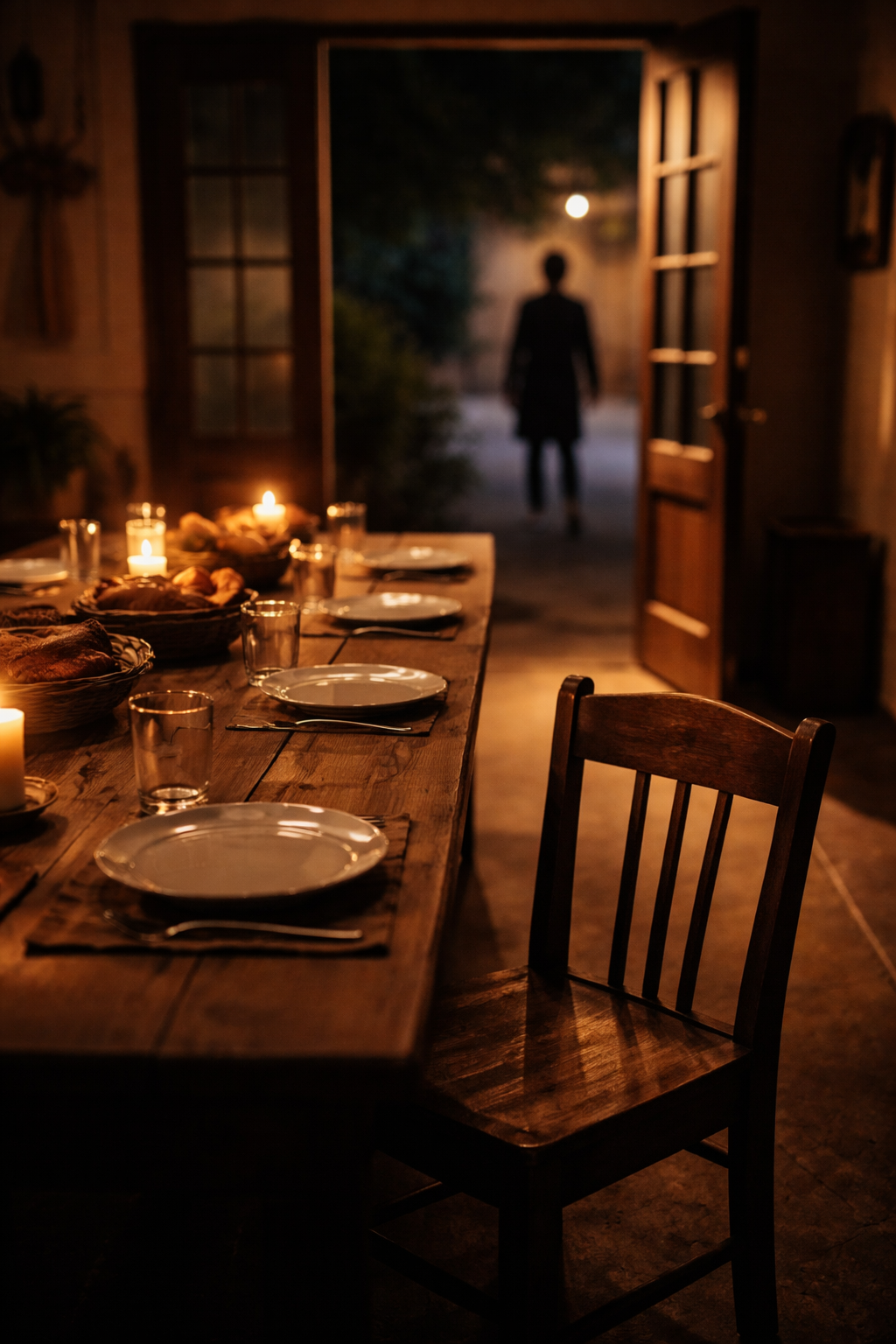
There is still room.
“Go out quickly into the streets and alleys of the town and bring in the poor, the crippled, the blind and the lame.” Luke 14:21
I. The Table Reveals the Heart
We have been tracing the movement of Jesus-shaped love. We have seen that love kneels. We have seen that love stays. We have seen that love crosses. Now, in Luke 14, Jesus teaches us one more movement: love makes room.
But to understand this, we have to sit inside the scene. Jesus is at a Sabbath meal in the house of a prominent Pharisee. This is a respectable room, a room of social choreography, governed by careful attention to rank, reputation, and religious performance. Everyone is watching Him, and He is watching them. In that setting, a Sabbath meal was never just lunch. It was also a public display of values, hierarchy, and belonging.
Before He ever speaks about the guest list, Luke tells us that a suffering man is there, swollen and vulnerable, while the Pharisees and experts in the law sit in silence and watch. The tension in the room is already thick. They want to see what Jesus will do. Will He value a person over their rules? Will He prize mercy over image? Jesus heals the man anyway, and then turns His attention to the guests choosing the best seats.
The contrast is devastating. In one part of the room sits a man whose suffering is visible. In the other sit people whose pride is hidden beneath polished lives and religious respectability. Jesus exposes both the visible brokenness in the room and the hidden brokenness at the table.
That is why this text cuts so deep. Jesus is not giving etiquette tips. He is exposing the architecture of the heart.
Tables are never just about food. They are about value. The guest list tells the truth about who we believe matters and who we have quietly decided is not our responsibility. It is one thing to talk about love in a sanctuary. It is another thing to arrange your actual life so that wounded people can belong there.
And I know how easy it is to feel loving as long as love stays manageable. I can care in ways that still leave me in control. I can pray, speak kindly, keep the right words in my mouth, and still feel my heart tighten when someone’s pain threatens to rearrange the room.
Jesus looks at that Sabbath table and basically says: the kingdom of God is not built like this.
II. The False Economy of Reciprocity
Then Jesus turns to His host and says, “When you give a luncheon or dinner, do not invite your friends, your brothers or sisters, your relatives, or your rich neighbors; if you do, they may invite you back and so you will be repaid” Luke 14:12.
He is uncovering the false economy that governs so much of human love: the economy of reciprocity.
In that world, and often in ours, every invitation carried a silent invoice. If I include you, you owe me something back. Maybe not money. Maybe not openly. But honor. Access. Loyalty. Status. Social capital. A place in your circle when I need it.
We are often willing to love as long as love functions like an investment. We like the invitation that is really leverage. We like the friendship that is really an alliance. We like the church dinner that looks warm on the outside but has invisible walls on the inside, walls that keep the conversation safe and the circle closed.
Jesus is exposing the kind of mercy that is really just networking with a Bible verse attached to it. If our love is only reserved for the safe and the impressive, we are not practicing the gospel. We are practicing self-interest with religious language draped over it.
And this is where the text gets costly. Jesus is not asking us to be nicer. He is asking whether we would still love if there were nothing in it for us. He is asking whether we are willing to spend our lives on people who offer no return on investment, no repayment, no advantage, no social reward.
That is not sentimental. That is sacrificial.
III. The Scandal of the Guest List
Then Jesus issues a command that should unsettle every respectable instinct in the room: “But when you give a banquet, invite the poor, the crippled, the lame, the blind” Luke 14:13.
Notice the weight of those names. These were not simply needy people in the abstract. These were people pushed to the edges of social life, people whose presence disrupted the atmosphere of a polished room. They were the kind of people respectable religion could serve from a distance but did not want seated nearby.
They are the people the city has learned to step around, the neighbors whose stories feel too messy, too complicated, too public, or too inconvenient to touch.
In our own city, this is still the scandal. Kingdom love moves toward the people who cannot improve your reputation. Jesus is centering the people we prefer to treat as background scenery. He does not say to study them as a project. He says to bring them in as family.
And if we are honest, this is where many of us get uncomfortable. We are often more willing to help people than to be interrupted by them. We will donate, advise, refer, and pray, but keeping real need at a safe distance still lets us preserve the emotional tone of the room.
So let the question land: Who in our city represents the kind of story that would make our Sunday morning feel off? Who would alter the tone of the room? Who can be served as a project, but not welcomed as a brother or sister?
Jesus will not let us hide there. He names the very people we would rather keep at arm’s length and tells us to bring them near.
If our truth does not sound like good news to the person trembling at the door, we have not yet understood the Host.
IV. The Danger of Ordinary Priorities
Jesus then tells the parable of the Great Banquet. The table is set, the food is ready, and the door is open. But the invited guests begin to make excuses: a field, five yoke of oxen, a new marriage.
The danger here is not scandalous rebellion. It is the weight of ordinary priorities.
That is what makes the warning so sharp. These are not obviously evil things. Work is not evil. Responsibility is not evil. Marriage is not evil. These are ordinary blessings. But here they become shields against grace. The scandal is not merely that people rejected the invitation. It is that they used good things to avoid the best thing.
That is still one of the most dangerous moves in the Christian life. We can use God’s gifts as excuses to avoid God’s presence. We can hide behind work, busyness, family, stress, timing, fatigue, or plans. We do not reject the Host with a shout. We reject Him with a “not right now.”
And “not right now” is one of the most dangerous phrases in the human soul. It feels like a delay. It functions like a rejection.
This is the depth of the warning: we do not only drift from God through open sin. We also drift through crowded loyalties. We assume we belong at the table while we are quietly ignoring the One who prepared it.
It is possible to live near the things of God and still refuse His invitation because grace interrupts your plans.
V. The Gospel Turn: The Beggar’s Seat
But before this passage becomes a command for us, it is a revelation of our own condition.
We must sit in the discomfort of Luke 14 until we realize that we were not the honored guests. We were the ones with no claim to a seat and no way to repay the Host for His mercy. We did not earn our place. We were brought in by grace.
We were the ones in the streets and alleys. We were the ones who could not put God in our debt. We were the ones who had nothing to leverage and no righteousness to present. The Host made room for us when none was owed.
And for the Christian, that grace finds its fullest expression at the Cross. Jesus took the place of the excluded so that we could be welcomed at the table of grace. He bore rejection so that we could receive mercy.
That is the great exchange.
The Lord did not look at us and say, “Now there is someone who improves the room.” He did not invite us because we were impressive, polished, or easy to love. He made room for us by mercy.
And once that gets into your heart, it becomes very hard to keep acting like grace was meant only for people who already know how to behave around the table.
Therefore, the church cannot be a gathering of respectable people managing appearances. It must be a sanctuary for the broken. We extend mercy not from a throne of superiority, but as beggars who have finally found the Bread of Life.
VI. The Sacred Guardrail
Finally, we must be incredibly clear: love makes room for the wounded, but it does not enable the wound-maker. Jesus-shaped love is truth-filled. Making room does not mean calling darkness light or blessing what God calls sin.
You can love from a distance when nearness becomes dangerous. Leaving harm is not unbelief. Sometimes it is obedience. We stay in the posture of mercy, but we refuse to participate in what destroys.
Real grace makes the truth bearable because it is carried by love. But grace is never moral confusion. The same Jesus who widens the invitation also tells the truth about excuses, refusal, and judgment.
So we make room without surrendering holiness. We welcome the struggler without baptizing the chains that bind them.
VII. The Final Word
Love kneels. Love stays. Love crosses. And now we learn: love makes room.
It makes room in the schedule, room in the heart, and room in the life we have spent so long arranging around ourselves. It is possible to live here and never cross into those messy realities, not because we are evil, but because we have learned to keep our mercy inside a manageable circle.
Left to myself, I will keep redrawing the circle until it protects my comfort. I will call it wisdom. I will call it boundaries. I will call it discernment. And some of it may even sound religious.
But Jesus breaks the circle.
He reminds me that I was once brought in the very same way: by mercy I did not deserve. And in this parable, grace is not passive. The master keeps sending his servant back out. Mercy moves. Mercy searches. Mercy calls.
So what is your field?
What good thing have you turned into a shield against grace?
What excuse have you polished until it sounds responsible, even spiritual?
The worst thing you can do is stand outside the feast making excuses while mercy is calling your name.
There is room for the ashamed.
There is room for the weary.
There is room for you.
So, come in.
Amen.