Love Stays in the Storm
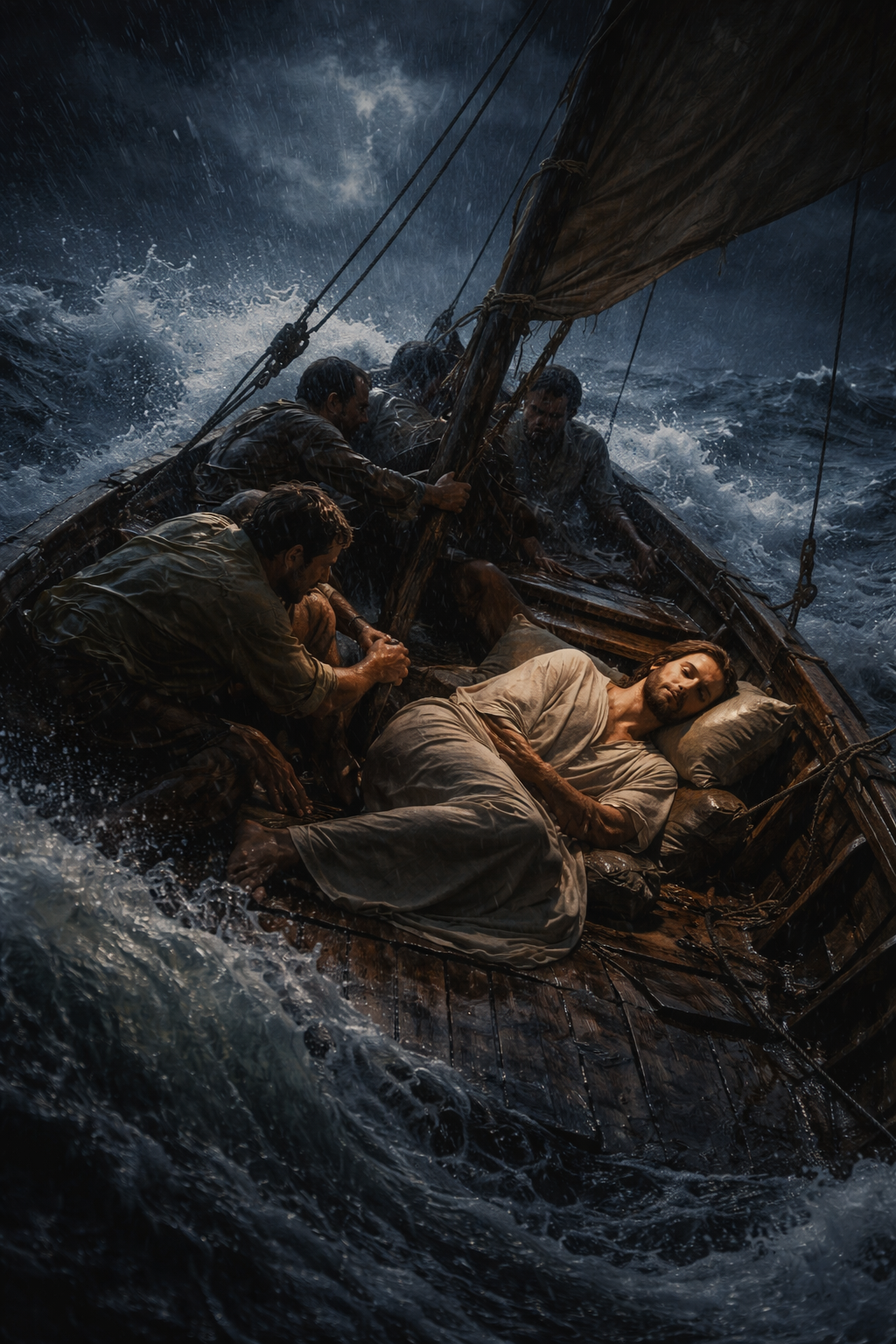
Peace in the storm.
“Teacher, don’t you care if we drown?” (Mark 4:38)
I. The Illusion of Smooth Waters
We have a dangerous habit of translating God’s love into easy weather. We assume that if we are walking with Jesus, if we are washing feet and crossing roads, then the sea should calm down out of respect for our obedience.
But Mark tells us something that ruins that illusion. Jesus is the one who says, “Let us go over to the other side.”
He did not drift into the storm. He led them into open water.
Following Jesus does not guarantee calm conditions. It guarantees a faithful destination. Now let me be clear: I do not believe God throws storms at His children as punishment. The world is broken, people sin, bodies fail, and creation groans. Storms come. But storms do not get the final word.
God may not author the storm, but He is not absent from it. He takes what would destroy you and He works it, mysteriously and faithfully, into your good. So when the waves rise, do not rush to the conclusion that you missed God. Sometimes you are in the gale because you followed Him into a world that bleeds.
The promise of discipleship is not exemption from the storm. The promise is the presence of the King in the waves.
II. When Competence Hits the Wall
The disciples were not hobbyists. These were seasoned sailors who knew the Sea of Galilee like the back of their calloused hands. But this storm was bigger than their résumé.
Fear is what happens when your competence finally runs out. It is that moment when you realize that your strategies, your discipline, your best intentions, all of it, cannot stop the boat from taking on water. In our lives, storms do not always look like waves. Sometimes they look like a stack of papers that tells a story you cannot fix. Sometimes they look like a family fracture that will not mend. Sometimes they look like the weight of a city’s grief with case numbers attached. It is the gut punch realization that you cannot work harder and stop someone else’s heartbreak. You are just standing there with a bucket in a sinking ship, praying with your teeth clenched.
When I was seven years old, I learned what that feels like. I found out my grandmother had cancer again. It was the second time, and this time it came back more aggressive. I did not really understand what cancer meant, but I understood what it did. I watched her start to get sick. I watched chemo and radiation take their toll. So I prayed, with the faith of a child that does not know how to edit itself. I asked God to heal my grandmother, night after night, and she only got worse.
One of the most vivid memories of my childhood happened in her living room. She was sitting in her recliner watching television when she decided she wanted something to drink. She clung to independence. She stood up, took her walker, and started toward the kitchen. She only took a few steps and then she stopped. Not because she changed her mind. Not because she got tired. She just froze.
Fear and helplessness overwhelmed her. Tears began to roll silently down her cheeks. I knew something was wrong. I could feel it with everything in me. “What’s wrong, Grandma?” I asked.
Her voice cracked. “I can’t move,” she said. “I want to. But I can’t.”
She stood there for maybe thirty seconds, but it felt like thirty minutes. Then, as suddenly as it had struck, it faded. She kept walking to the kitchen and got her drink. I remember standing there, seven years old, not knowing what to do with the fear in my hands.
Within a few weeks, I found myself at the hospital. My grandmother was lying in a bed. I knew she was sick, but I was too young to realize she was nearing the end. She spoke to each person individually. She apologized to each person. Then she looked up at the ceiling and tears rolled down her face as she whispered, “I’m sorry.”
After my grandmother passed, I was angry at God. I did not understand why He would not save her. If God is good and God is love, why would He allow her to get sick and stay sick? Why would He let her die? If God can do anything, could He not make His own grandma? Why did He have to take mine?
I am not telling you that as a neat testimony. I am telling you because that is the boat. That is what it feels like when the water keeps rising and heaven feels quiet. As a child, I did not know Mark 4 at seven years old, but I knew the question before I knew the verse. “Teacher, don’t you care if we drown?”
But now, as an adult, I look back at that moment in the hospital. When my grandmother turned her eyes toward heaven and whispered, “I’m sorry,” I do not hear defeat in that sentence anymore. I hear a soul making amends. I hear someone reaching for God in the dark. I cannot rewrite the loss. I cannot pretend it did not hurt. But I can see, even there, a kind of love that stays.
III. The Offensive Silence
Then there is the cushion. Mark mentions that Jesus is in the stern, head on a cushion, sleeping. To an anxious heart, that is not a peaceful image. It is offensive. It looks like negligence. When your arms are burning from bailing water and your throat is tight with dread, God’s silence feels like apathy.
But I am learning that Christ’s rest is not because the storm is small. It is because His Father is steady. We keep asking for a Savior who will panic with us so we feel validated. Instead, we have a Savior who invites us to trust with Him so we can be remade. Sometimes love does not shout at the wind right away. Sometimes love just stays in the boat while it rocks and waits for you to realize that you have not lost your soul yet.
IV. The Voice Over the Wind
Eventually they wake Him. Not with a gentle tap, but with that desperate, accusing prayer that sounds like panic and feels like betrayal: “Teacher, don’t you care if we drown?” They are not asking for a sermon. They are asking for survival.
And then Jesus stands up.
Mark does not describe a ritual. No warm up. No negotiation. He speaks like Someone who has authority over what is trying to kill them. He rebukes the wind and says to the waves, “Quiet! Be still!” The storm does not fade out politely. Mark says, “The wind died down and it was completely calm.” One moment the boat is being swallowed. The next moment the water lies down like it recognizes its Maker.
But Jesus does not stop with the sea. He turns and looks at the people He loves and asks the question that cuts deeper than the wind: “Why are you so afraid? Do you still have no faith?” He is not shaming them for being human. He is exposing what the storm uncovered. Not just that they were afraid, but that they did not yet understand who was in the boat.
And then something shifts. Mark says, “They were terrified and asked each other, ‘Who is this? Even the wind and the waves obey him!’” They are no longer afraid of drowning. They are afraid of the truth. The storm revealed their weakness, but the calm revealed His authority. The greatest threat in this story was never the weather. It was the possibility of being close to Jesus and still not trusting Him.
V. The Steel in the Stay
We have to be incredibly clear about something: Jesus shaped love stays in hardship, but it does not stay in harm. There is no holiness in staying in the path of a hand that strikes you or a voice that demeans the image of God in you. Leaving that kind of danger is not unbelief. Sometimes it is the most obedient thing you will ever do. Stop calling danger devotion.
But you do stay in the boat with the friend who is drowning in their own choices. You stay in the gap for the neighbor who has lost their way. You stay when the debt remains, when the diagnosis is final, and when the addiction does not break on your timeline. If we only define love by results or wins, we will quit the second the storm refuses to cooperate. But God is forming something deeper than an outcome. He is forming a love that stays when the water is cold and you do not even have the words to explain why you are still there.
VI. Becoming the Safe Harbor
This world is tired of people who can explain the weather. It needs people who are anchored. It needs people who can sit in the dirt with the suffering without looking for the nearest exit. That is what discipleship looks like when it finally grows up. It is not flashy. It is steady.
Storms are not blessings, but God does not waste them. The storm tries to break you. God uses it to reveal what is actually inside you, and then He remakes the pieces. The greatest gift is not an explanation or a closed case file. It is the fact that when you look across the rocking boat, the King is still there.
The Final Word
If He is in your boat, you are not forgotten. You might be wet, you might be terrified, and you might be exhausted, but you are not alone.
Lord, teach us to trust the silence. Teach us to breathe when the boat shakes. And help us become a harbor for someone else, not because we have mastered the sea, but because we know the One who owns it.
Love stays.
Amen.