Love Carries the Weight
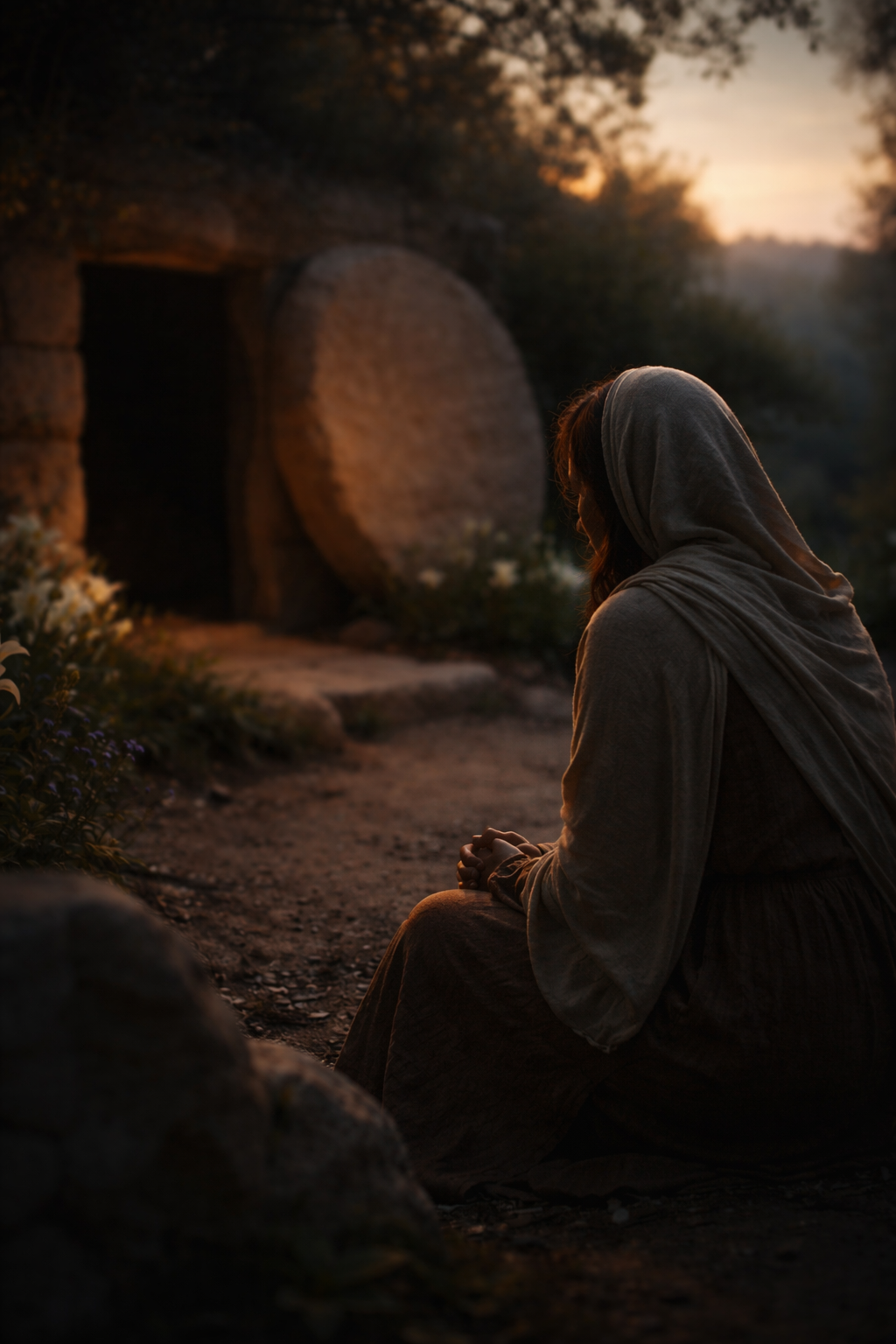
The Tomb, While It Was Still Dark
“Sir,” she said, “if you have carried him away, tell me where you have put him, and I will get him.” John 20:15
I. Love Shows Up While It Is Still Dark
John opens the resurrection account with a detail that defines the nature of discipleship: Mary Magdalene went to the tomb early on the first day of the week, while it was still dark. She did not wait for the sun to rise. She did not wait for her theology to settle. She did not wait for clarity to return.
She moved while the grief was still a physical weight, and the sky was still dark.
This is the first mark of Jesus-shaped love: it does not wait for all the answers to arrive. It moves toward the Lord even when the heart is broken and the mind cannot yet make sense of what God is doing.
Mary is not coming for a miracle. She is coming because love has a momentum that outlasts hope. She is walking toward what she believes is a sealed tomb and a finished story. And still her feet keep moving.
That is often how love works. It shows up while it’s still dark.
And some of you know that darkness. You know what it is to keep showing up while it is still dark. To keep praying while it is still dark. To keep grieving while it is still dark. To keep obeying while it is still dark.
Mary comes to the tomb and finds the stone moved. She runs to tell Peter and John. They come. They look. They begin to put pieces together. And then they leave.
But Mary stays.
And sometimes the deepest revelation of the risen Christ does not come to the fastest runner or the sharpest mind. Sometimes it comes to the one who is too broken to leave the place of pain.
II. The Liturgy of Lingering
Verse 11 says, “Now Mary stood outside the tomb crying.”
She is crying because love is disoriented when it can’t find the one it loves.
She had already watched Him die. She had already endured the horror of the Cross. And now, as far as she knows, even His body is gone. In her mind, grief has deepened into confusion. Loss has become absence.
And still she stays there.
That is one of the most moving things in all of Scripture to me. Mary stays near the last place she knew Him to be. She lingers where her heart was broken.
We do not like that kind of love. We prefer efficient love. Managed love. Love that can process its pain, extract the lesson, and move on according to schedule. But Mary practices a kind of holy lingering. She remains where the ache is.
And heaven does not rebuke her for it.
She stoops to look into the tomb and sees two angels in white, and they ask her, “Woman, why are you crying?” Not because heaven doesn’t know, but because the Lord is often kind enough to let sorrow speak.
There are moments in life when all you really have to offer are tears at the tomb. No polished prayer. No tidy theological summary. No dramatic display of strength. Just grief, presence, and the refusal to walk away.
And John 20 tells us that heaven meets people there.
III. Love in the Dark
Mary says, “They have taken my Lord away, and I don’t know where they have put him.”
Notice the tenderness of that sentence: “my Lord.”
Even in grief, He is still hers. Even in confusion, He is still hers. Even when she thinks someone has taken His body, love still speaks with attachment, devotion, and ache.
Then John gives us one of the most human moments in all the resurrection accounts. She turns and sees Jesus standing there, but she does not realize that it is Jesus.
Grief can do that.
Sometimes the risen Christ is nearer than we know, but pain distorts the outline. Tears blur the face. Sorrow narrows our vision until all we can see is what we think we have lost.
Jesus asks her, “Woman, why are you crying? Who is it you are looking for?”
That is not just Mary’s question. It is the question under every ache.
Who are you looking for?
What do you think you have lost?
What is your heart reaching for in the dark?
John says she supposed He was the gardener.
It is a misunderstanding, but it is a beautiful one. She is wrong, and yet not entirely wrong. Because the risen Christ really is standing in the garden of a ruined world, beginning new creation where death had done its worst.
But the point is not Mary’s insight. The point is that Jesus is already there, standing in the middle of her confusion.
IV. The Impossible Weight
Then Mary says one of the most beautiful things grief has ever said:
“Sir, if you have carried him away, tell me where you have put him, and I will get him.”
That is a sentence too big for her strength.
A single grieving woman cannot carry the body of a dead man by herself. The words outrun the body. The love outruns the logistics. The devotion outruns the practical reality.
But that is precisely why the sentence matters.
Love does not care about the weight.
It says, “Just tell me where He is.”
It says, “I will go.”
It says, “I will carry what I can.”
Mary is not speaking with muscle. She is speaking with love.
And everyone who has ever really loved someone understands that sentence. A parent understands it. A husband understands it. A wife understands it. A friend understands it. A grieving soul understands it.
“Just tell me where they are.”
“I’ll go.”
“I’ll bear the weight.”
Mary’s heart ran ahead of her strength.
And Jesus honored that devotion.
I know something about that instinct. I often want to be the one who carries the weight, who solves the problem, who keeps the grief from spilling over onto everyone else. But there are nights when the burden is simply too heavy for my hands. I have stood at my own tomb of exhaustion, ready to offer a strength I do not actually possess, only to find that my “I will get him” is not a statement of ability, but a cry of love.
Love cares about the beloved more than the burden.
V. The Name That Breaks the Darkness
Then Jesus says one word:
“Mary.”
That is all.
Not a lecture. Not an explanation. Not a theological outline.
Just her name.
And with one word, the darkness breaks.
She had heard that voice before. She had heard Him speak her name before. And in that instant, confusion gives way to recognition. The Shepherd calls His sheep by name, and the sheep know His voice.
She turns and cries out, “Rabboni!” which means Teacher.
That is the turning point of the whole story. Not that Mary figured it out by her own brilliance. Not that she reasoned her way through the evidence. But that Jesus called her by name.
Resurrection is personal.
He is not alive in the abstract. He is alive enough to know her, to meet her grief, and to call her out of confusion by name.
That is still how He works.
There are moments when the whole world feels like an empty tomb and unanswered questions. And then, somehow, through the Word, through prayer, through worship, through a holy interruption you did not expect, the risen Christ calls your name.
And suddenly this is not just doctrine. This is not just Easter language. This is encounter.
He is here.
He is alive.
He knows me.
He has not lost me in my grief.
VI. From Clinging to Commission
Jesus says to her, “Do not hold on to me, for I have not yet ascended to the Father.”
At first, that sounds abrupt. But it’s mercy.
Mary wants to hold on to Him the way she knew Him before. But resurrection is not the return of the old life. It is the beginning of the new.
Jesus is not merely back. He is risen.
Mary cannot remain only in the posture of grief or even in the posture of personal attachment. She is being moved into mission. She is not being pushed away from Him. She is being entrusted by Him.
That is why Jesus says, “Go instead to my brothers and tell them...”
She came looking for a corpse. She leaves carrying a message. She came bent under grief. She leaves entrusted with good news. She came asking, “Where is Jesus?”
She leaves declaring, “I have seen the Lord!”
That is what resurrection does. It turns mourners into witnesses.
And notice who receives this commission. Not the most polished disciple. Not the strongest public figure. Not the one who stayed composed. But Mary Magdalene, the weeping woman in the garden.
The witness is born not from polished strength, but from encounter.
VII. The Final Word
Maybe you came in today still in the dark. Maybe you are standing outside some tomb in your life, crying. Maybe you are carrying a grief that has outlasted your explanations. Maybe all you can say is, “Just tell me where He is.”
Hear this: He is not absent from your tears.
Love kneels.
Love stays.
Love crosses.
Love makes room.
And here we learn this too:
Love carries the weight.
Or at least, it thinks it must.
Mary says, “I will get him.” She is ready to carry a weight she cannot possibly bear. But the deeper truth of the Gospel is that she does not carry the risen Christ back into life.
He carries her out of despair.
She came looking for a body and left with a name on her lips. She came bent under grief and left bearing witness to resurrection. She thought love meant carrying Him, but in the end she discovered that the risen Lord was the one carrying her.
And He still does.
Amen.