Love Restores
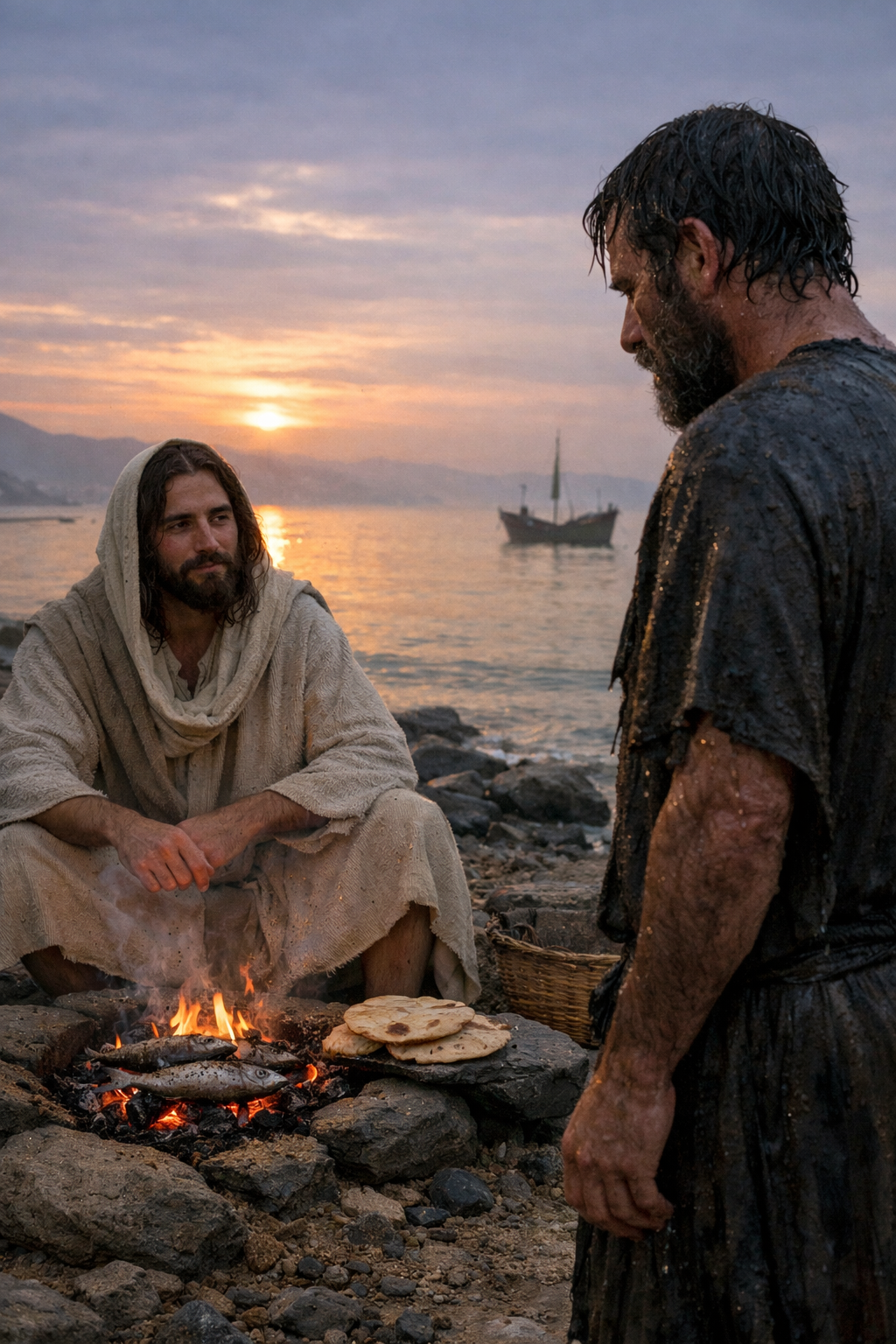
The Fire That Restored Him
When they had finished eating, Jesus said to Simon Peter, “Simon son of John, do you love me more than these?” John 21:15
I. When Shame Takes the Whole Frame
In design, we talk about visual weight. Certain elements pull the eye first. They dominate the composition. Even if there are other important things in the frame, one dark or oversized element can quietly control the whole image.
Shame works like that in the soul.
It takes one moment, one wound, one failure, and gives it so much weight that it begins to overshadow everything else. It drags the eye back to the same place over and over again until that one dark point starts to feel like the truest thing about you.
That is what I see when I look at Peter in John 21.
I do not see a distant religious figure made of stained glass and certainty. I see a man whose whole inner life has been dragged back to one fire, one night, one terrible collapse. I see a man whose background has swallowed his foreground. The memory of denial has gained so much weight that it threatens to define the whole composition of who he is.
And I know something about that.
I know what it is like to carry a memory that acts like a watermark across everything you try to build. The quiet knowledge that you were not who you claimed to be in the moment it mattered. The kind of memory that stains your confidence, follows you into prayer, follows you into work, follows you into silence, and makes you wonder whether every new thing you are trying to build is still being haunted by an old failure underneath it.
That’s how shame works.
Guilt says, “I did something wrong.”
Shame says, “I am something wrong.”
Guilt can lead a person to repentance. Shame wants to trap a person in identity. Shame is not content to tell you that you failed. It wants to narrate you. It wants to interpret your life. It wants to take your worst moment and turn it into your final name.
For Peter, that moment happened beside a charcoal fire.
Not in private. Not in some hidden corner where no one knew. Publicly. Repeatedly. Beside a fire, with the cold in the air and fear in his throat, Peter did not merely hesitate. He denied the Lord. The one who had sworn loyalty. The one who had spoken boldly. The one who had promised to stand when others fell. He folded in the dark.
And once that happened, I imagine it would have been hard for Peter to hear his own name without hearing the echo of that night behind it.
Maybe you know that feeling.
Maybe not Peter’s exact failure, but that feeling. The feeling of having one moment in your life that keeps returning like a witness you cannot silence. The feeling of being haunted by the gap between who you said you were and what you actually did when fear took hold. The feeling of trying to move forward while some part of you still believes the most honest thing about you is what happened at the fire.
That is where John 21 meets Peter.
Not at the height of heroic discipleship.
Not in some triumphant spiritual pose.
Not while he is leading with confidence and clarity.
John 21 meets him in the quiet after collapse. In the place where the adrenaline is gone, the excuses are useless, and the weight of what happened has finally settled in.
And that is where the risen Christ comes looking for Peter.
Jesus does not only meet the grieving. He also meets the ashamed.
II. The Mercy of Another Fire
John tells us that when the disciples come ashore, they find a charcoal fire there, with fish on it and some bread.
That detail matters more than it seems.
The last charcoal fire Peter stood beside was the one near the high priest’s courtyard, where he denied Jesus. Now John brings him to another fire. That is not accidental. The Gospel is deliberately leading Peter back to the place of memory. But this time, the fire is no longer surrounded by accusation. This time, it is surrounded by mercy.
The first fire held fear.
This fire holds breakfast.
The first fire was cold with denial.
This fire is warm with welcome.
The first fire was framed by suspicion and collapse.
This fire is framed by provision and presence.
That is how Christ often heals.
He doesn’t erase the memory of the wound. He brings us back through it, but not to destroy us there. He brings us back to meet us there differently. He takes the place shame had claimed and fills it with mercy.
And notice the order of grace in the passage.
Before the questions come, there is breakfast.
Before the restoration, there is presence.
Before Peter is asked to speak, he is welcomed to the shore.
That is the kindness of Christ.
The risen Lord, the One who conquered death, is not standing there pacing with folded arms. He is not opening with accusation. He is not forcing Peter into some public spectacle of humiliation. He is standing by the fire, feeding the very men who failed Him.
That picture is holy.
Because so many of us imagine God waiting for us at the shoreline with disappointment already loaded into His voice. We imagine that the first thing He wants from us is an explanation. Or an apology polished into the right shape. Or some proof that we finally hate ourselves enough to be acceptable again.
But John 21 gives us a different Christ.
He begins with bread.
He begins with fish.
He begins with fire.
He begins with welcome.
“Come and have breakfast.”
That is grace in ordinary form.
And there is something deeply beautiful about the ordinary form of it. Jesus does not begin Peter’s restoration with a thunderclap. He begins with breakfast on the shore. The Lord of resurrection stoops into the plainness of a morning meal. He meets Peter in hunger before He meets him in speech.
That is important because restoration is not only theological. It is personal. It is relational. Christ is not merely solving Peter’s problem. He is drawing Peter back into fellowship.
Before Peter is restored to service, he is received in mercy.
Some of you may need that truth more than anything else in this sermon. Before the hard conversation, before the reckoning, before the calling, there is the table. Before Jesus asks anything of Peter, He gives something to Peter.
That is the order of grace. God’s mercy is not payment for our performance. It is the ground on which restoration begins.
III. The Question Beneath the Ruin
Then, after breakfast, Jesus turns to Simon Peter and asks, “Simon son of John, do you love me more than these?”
He does not begin with Peter’s nickname, the name of strength. He addresses him plainly and personally, as if to say: we are going to tell the truth here.
And this question is the center of the whole passage.
Jesus does not ask, “Why did you do it?”
He does not ask, “What were you thinking?”
He does not ask, “Can you defend yourself?”
He does not ask, “Promise Me you will never fail again.”
He asks, “Do you love me?”
That question reaches deeper than performance. It cuts beneath Peter’s collapse and goes straight to the center of his heart. Failure had covered Peter’s life in rubble, but Jesus asks the one question that gets beneath all of it.
Beneath the fear, is love still there?
Beneath the shame, is love still there?
Beneath the memory of what you did, is love still there?
Peter answers, “Yes, Lord; you know that I love you.”
It is a quieter answer than the old Peter would have given. There is no bravado here. No comparison to the others. No swelling confidence. No chest-thumping promise that he will do better than everyone else. Failure has burned a great deal of noise out of him.
And there is mercy even in that.
The old Peter was loud and sincere, but unstable. The Peter standing on this shore is humbler now. Sadder, perhaps. More honest. He has learned something about himself. He knows now what fear can do. He knows how weak the flesh can be. He knows the distance between his promises and his actual strength.
And Christ can do more with honest love than with dramatic promises.
Then Jesus asks again.
And again.
Three times.
The number is not accidental. Peter denied Him three times, and now Jesus gives Peter three opportunities to speak love where denial once lived.
This is not humiliation. It is healing with precision.
Jesus is not rubbing salt in the wound. He is rebuilding the man at the exact place where he broke. He is undoing, confession by confession, what fear once produced under pressure.
And John tells us that by the third time, Peter was hurt. Of course he was. Restoration is mercy, but mercy is not always painless. Sometimes healing hurts precisely because it reaches the place we would rather leave buried.
But buried wounds do not become healed wounds. They become hidden wounds. And hidden wounds still govern a life.
Jesus loves Peter too much to leave the wound untreated.
So He asks the question again until Peter is brought all the way through the truth and out the other side. Not because Jesus delights in Peter’s pain, but because Jesus is not satisfied with surface repair. He wants full restoration.
Some of us would prefer a Savior who says, “Let’s just not talk about it.” But that kind of mercy would leave us unhealed. Jesus is better than that. He is tender enough to feed Peter, and faithful enough to confront him. He is kind enough to welcome him to the shore, and loving enough not to leave him trapped in silence.
That is the mercy of Christ.
Truth without abandonment.
Exposure without humiliation.
Healing without illusion.
IV. Restored for the Sake of Others
Each time Peter answers, Jesus responds with responsibility.
“Feed my lambs.”
“Tend my sheep.”
“Feed my sheep.”
This is one of the most astonishing parts of the whole scene.
Jesus does not say, “I forgive you, but your usefulness is over.”
He does not say, “You failed publicly, so your future is limited now.”
He does not say, “You may remain near Me, but I can never trust you again.”
He gives Peter sheep.
The man who could not faithfully stand by a fire is now entrusted with a flock.
That is the scandal of grace. Christ does not merely pardon Peter. He recommissions him.
And that matters, because many people can imagine being tolerated by God. Fewer can imagine being trusted by Him again.
We can imagine God allowing us back into the room. We can imagine being forgiven in some abstract sense. But to believe that God would place anything tender in our hands after seeing our weakness, after seeing our fear, after seeing our collapse, that is harder for many of us to believe.
And yet that is exactly what Jesus does here.
He entrusts care to the man who failed.
Now let us be clear. This does not mean failure has no consequences. It does not mean trust never needs to be rebuilt. It does not mean wisdom and accountability no longer matter. Christianity is not fantasy. Sin does damage. Some things require slow repair.
But it does mean this: shame does not get final authority over the future of someone Christ has restored.
In the world we know, failure often follows people for years. One collapse can follow a person into every room after that. A record can become a label. A worst moment can become a category. A human being can be flattened into the darkest line on the page.
But the kingdom of God is not ruled by shame’s paperwork.
Failure does not have unilateral authority to define your trajectory. Christ does.
And notice something else here. Jesus restores Peter not merely for Peter’s comfort, but for the sake of others. “Feed my sheep.” Restoration is never merely private therapy for the soul. It becomes care for the flock. The restored become servants. The healed become shepherds. The one who has received mercy is now commissioned to become an instrument of mercy to others.
That is often how Christ redeems the wound. He does not waste it. He forms in the restored person a tenderness that would not have existed without the breaking.
Peter will not care for Christ’s people as an untested man. He will care for them as someone who knows what it is to fail and still be loved. He will care for them as someone who has met mercy at the shoreline.
And people led by that kind of person are often safer than people led by strength alone.
V. The Cost of a Restored Life
Then Jesus tells Peter that a day is coming when he will stretch out his hands and be led where he does not want to go. John tells us this was to indicate the kind of death by which Peter would glorify God.
That is sobering.
Restoration did not lead Peter to a safer life. It led him to a costlier one.
Many of us quietly assume that if God restores us, the rest of the road should now be easier. We think that after enough tears, enough regret, enough grief, surely the next chapter should be gentler.
But Jesus restores Peter into faithfulness, not comfort.
The old Peter had made loud promises and failed under pressure. The restored Peter would one day live the truth he once could only speak. Christ was not merely giving him back his place. He was forming in him a deeper kind of love, one that would hold when obedience became costly.
Immature love is loud.
Mature love endures.
Immature love speaks quickly.
Mature love stays when the cost arrives.
Immature love trusts its own strength.
Mature love clings to Christ when its own strength is gone.
And then Jesus says the words that started it all once before:
“Follow me.”
That is the future tense of grace.
Jesus does not chain Peter to the fire behind him. He calls him toward the road ahead.
Not, “Explain the past.”
Not, “Punish yourself for the next ten years.”
Not, “Keep replaying your failure until you feel worthy again.”
Not, “Remain forever defined by the night the rooster crowed.”
Just this: “Follow me.”
The past is not ignored. But neither is it allowed to rule.
That is what grace does. It tells the truth about the past without surrendering the future to it. It does not pretend the wound never happened. It simply refuses to let the wound become lord.
VI. For Those Living Beside Their Own Fire
Not everyone has a public failure like Peter. Not everyone has some dramatic collapse they can point to and name in a single sentence.
But many people know what it is to live beside their own fire.
You know what it is to remember the moment fear made you silent. You know what it is to remember when obedience became expensive and self-protection won. You know what it is to carry the quiet knowledge that you were not what you claimed to be in the moment it mattered.
Some denials happen with words. Others happen by the shape of a life.
And shame always wants to turn that into an identity.
Maybe your fire is a betrayal.
Maybe it is a compromise.
Maybe it is a season of silence when you should have spoken.
Maybe it is a private sin you thought would stay private.
Maybe it is not one dramatic collapse at all, but the slow ache of knowing you have been living at a distance from God while still trying to appear intact.
Whatever form it takes, shame has one sermon it loves to preach: “This is who you are now.”
But the point of John 21 is not that Peter was secretly fine all along. He was not. The denial was real. The grief was real. The wound was real.
The point is that the risen Christ is willing to walk straight into the aftermath and restore what shame declared unusable.
That is the hope of the Gospel.
Not that you were never broken.
Not that the wound did not happen.
Not that your failure was smaller than it felt.
But that Jesus is greater.
He is willing to bring you back through memory, through honesty, through mercy, and into a future that shame said you no longer deserved.
And maybe that is where this text presses hardest on some of us. We can imagine forgiveness, maybe. But usefulness? Calling? A future? We are less sure. We suspect that grace may let us limp into the room, but not hold anything fragile again.
Yet Jesus says to Peter, “Feed my sheep.”
Which means the Gospel is not only about canceled guilt. It is about reclaimed purpose.
The Lord who restores also sends.
VII. The Final Word
Love kneels.
Love stays.
Love crosses.
Love makes room.
Love pours out.
Love carries the weight.
And here we learn this too:
Love restores.
It restores not by ignoring the wound, but by touching it.
Not by flattering the fallen, but by calling them back.
Not by pretending the past never happened, but by proving that grace is stronger than it.
Peter came to that shore carrying the memory of a fire he wished he could forget. And Jesus met him there with another fire, another morning, and another chance to speak the truth.
That is how Christ loves.
He does not merely forgive from a distance. He comes near enough to rebuild what fear tore down. He does not leave His people in the ashes of their worst moment. He calls them forward.
I know what it is like to believe that failure puts a watermark across everything after it. To think that maybe grace might forgive, but never fully restore. To wonder whether the worst moment has already said the truest thing about you.
But John 21 will not let me stay there.
The risen Christ is still on the shore.
The fire of mercy is still burning.
Grace still speaks after failure.
And shame does not get the final word.
So stop rehearsing your collapse as though it were your final name.
Come ashore.
Tell the truth.
Receive the mercy.
Take the calling.
And follow Him.
Amen.