Love Crosses the Road
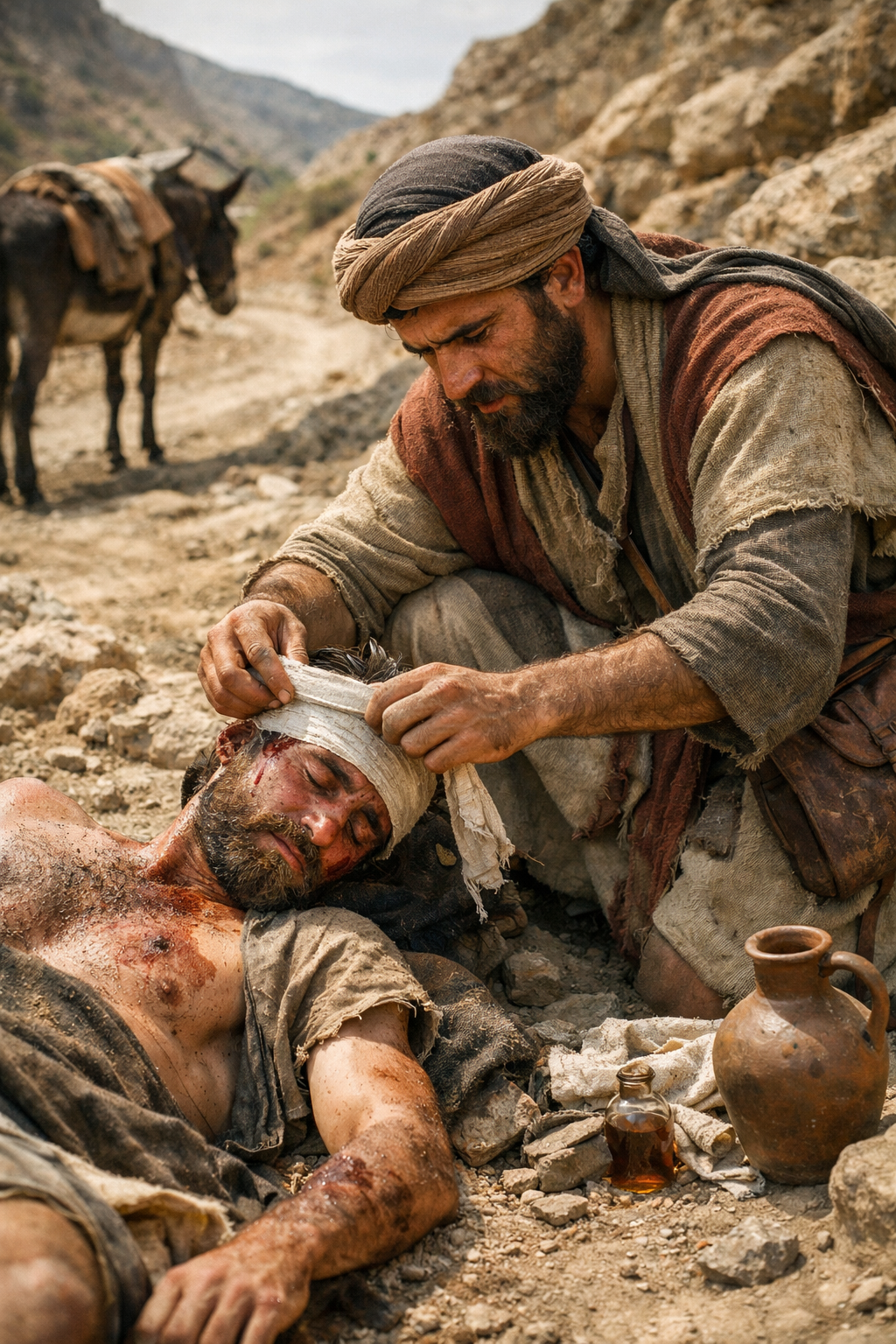
Love in action
“But a Samaritan, as he journeyed, came to where he was, and when he saw him, he had compassion.” Luke 10:33
I. The Direction of the Kingdom
Last time, we were in the Upper Room. We watched the King of Glory wrap a towel around His waist and scrub the manure off feet that did not deserve His hands. We learned the posture of the Kingdom: Love kneels.
But Jesus-shaped love cannot stay in a room with candles and songs. If the Upper Room gives us the posture of the Kingdom, the road to Jericho gives us the direction: Love crosses.
A love that kneels in the sanctuary must eventually become a love that moves in the street. This love is not defined by geographic proximity, ethnic similarity, or moral comfort. It is defined by a mercy that moves toward the wounded. Even when it costs you. Even when it disrupts you. And even when it places you next to people your heart would rather label “not my responsibility.”
II. The Search for a Loophole
The story begins with a “lawyer,” an expert in religious law. He doesn’t come as a disciple; he comes as a critic. He asks, “Teacher, what must I do to inherit eternal life?”
Jesus refuses to play the game of abstract theology. He turns the question back: “What is written in the Law?” The lawyer answers with the "greatest hits": Love God with everything you have, and love your neighbor as yourself.
Jesus says, “Do this, and you will live.”
But the text tells us the lawyer was “desiring to justify himself.” So he asks the question that has echoed through every generation: “And who is my neighbor?”
That is not a request for clarity; it is a search for a limit. It is the human heart asking, “How far do I have to go before I’m allowed to stop?” If the category can be narrowed, the command can be managed. If "neighbor" can be defined by a zip code or a social circle, then mercy can be kept small.
Jesus does not give him a definition. He gives him a mirror.
III. Religious Distance
“A man was going down from Jerusalem to Jericho…”
This road was a seventeen-mile descent through barren rock and jagged caves. It was a haven for bandits, an ancient "kill zone." Jesus introduces a man who is stripped, beaten, and left “half dead.” He makes the victim anonymous. No name, no tribe, no merit. Just a ruined human being in the dirt.
Then, a priest comes by. He sees the man and passes by on the other side. Then, a Levite. He sees the man and passes by on the other side.
These were the religious professionals. The ones who knew the songs and the scriptures. And Jesus is exposing a sobering reality: You can have devotion and still have distance. You can know the right words and still walk past the right need.
Why did they pass? Maybe they feared ritual defilement. If the man was dead, touching him would cost them their professional standing and their schedule. Maybe they feared a trap. But Jesus is not impressed by "wisdom" that protects your life while someone else bleeds out.
Sometimes, what we call “protecting our peace” is just a sanctified way of saying, “I refuse to get my hands dirty.”
IV. The Scandal: Mercy from the Wrong Person
“But a Samaritan…”
If you’ve heard this story too many times, you miss the slap in the face. To Jesus’ audience, a Samaritan was the "other." The wrong theology, the wrong blood, the wrong history. They were the people you blamed for the fracture of society.
And Jesus makes the outsider the hero.
The Samaritan doesn't offer polite sympathy. The text says he was "seized with compassion." It was a gut-level reaction. He allows the suffering of a stranger to interrupt his life.
That is the first mark of Jesus-shaped love: It makes room for need.
V. Mercy With Hands
The Samaritan does not give a speech. He does not take a picture of the ditch to post about it later. He goes to him. He binds the wounds. He pours in oil and wine—his own resources. He lifts the man onto his own animal, meaning the rescuer now has to walk so the wounded can ride.
He brings him to an inn and stays the night. In the morning, he pulls out two denarii—real money—and tells the innkeeper, “Take care of him. Whatever more you spend, I will repay you.”
That isn't a moment; it’s a commitment. Jesus-shaped love does not only kneel; it carries. It doesn't just start well; it follows through. It pays the bill for a recovery it didn't cause.
This is the second mark of Jesus-shaped love: It is tangible.
VI. Love That Costs
Notice the invoice for this mercy. It cost the Samaritan:
Time: His journey was delayed.
Comfort: He gave up his seat.
Money: He funded the restoration.
Safety: He stayed in the "kill zone" to do the work.
If love never costs you anything, it is probably just preference. It might be "niceness," but it isn't the Cross. Jesus-shaped love will eventually ask you to cross a road you wanted to stay away from.
VII. The Jericho Roads of Today
We all have "other sides of the road." We know the neighborhoods we avoid. We know the people whose stories feel too messy to touch.
In 2026 Indianapolis, the Jericho roads are everywhere. They are the families one eviction notice away from the street. They are the people carrying addiction like an open wound. They are the social ghosts of our city. It is possible to live here and never cross into those realities because we’ve learned to keep our mercy inside a manageable circle.
Jesus breaks the circle.
VIII. Boundaries are the Shape of Love
We must be clear: Jesus is not calling for naive martyrdom. The Samaritan was brave, but he was also wise. He involved an innkeeper. He created a plan. He provided for long-term care.
Jesus-shaped love does not require you to be a doormat for abuse. It does not mean you must remain in the path of a hand that strikes you. You can love a "Judas" from across a border. You can pray for a "robber" from a place of safety.
Sometimes, the most "Jesus-shaped" thing you can do is set a boundary that forces a person to face their own sin. Love moves toward the wounded, but it does not enable the wound-maker.
IX. The True Samaritan
Jesus ends by asking the lawyer: “Which of these three proved to be a neighbor?” The lawyer can’t even bring himself to say the word Samaritan. He mumbles, “The one who showed mercy.” Jesus says, “Go, and do likewise.”
But we will never "go and do likewise" until we realize one thing: We are not the Samaritan in this story. We are the man in the ditch.
Before this is a moral lesson, it is a Gospel revelation. We were the ones stripped and helpless. We were the ones the world passed by. And Jesus—the one we rejected, the one we considered an outsider—did not stay on the other side. He crossed the greatest road in the universe to reach us. He touched our brokenness. He carried our weight. He paid a debt He did not owe to heal a wound He did not cause.
The Final Word
A love that kneels in the sanctuary must become a love that crosses the road. We are building a foundation on our knees so that we have the strength to walk into the ditches of this world.
Lord, teach us to see. Teach us to stop. And remind us that we only have the power to cross the road because You first crossed it for us.
Amen.